Wednesday, December 31, 2025

The Midnight Blogpost

The Moon on New Year's Eve

If you're looking for something to read
when the clock strikes twelve, how about this novel
concerning the quirks and tweaks and funny tricks of time:

The Midnight Library by Matt Haig

At least 4 friends (Gene, Katy, Kerry, Laura), all on separate occasions, recommended this novel; plus, it was a clue on Jeopardy! so I knew it was going to be a good one. I admit that I was not consistently enamoured of Nora and the multiverse, but I was perpetually enthralled by the manner in which it brought to mind so many other things that I deeply love, such as
1. This poem by Ernest Sandeen

My Two Lives

The life I could have lived,
that other, better one,
is also mine. Who else
can claim it?
Each morning, stooping down,
I know that I am not worthy
to tie my own shoelaces.


Ernest Sandeen, 1908 - 1997
Notre Dame Professor and Poet

2. This poem by H. D.

Never More Will the Wind
Never more will the wind
cherish you again,
never more will the rain.
Never more
shall we find you bright
in the snow and the wind.
The snow is melted,
the snow is gone,
and you are flown:
Like a bird out of our hand,
like a light out of our heart,
you are gone.


by H.D. (aka Hilda Doolittle, 1886 – 1961)

3. The dreamy (also nightmarish) poetic novel:
Einstein's Dreams by Alan Lightman

4. The dreamy (also nightmarish) historical novel:
Life After Life by Kate Atkinson

5. The Mirror of Erised -- Desire reversed -- in the Harry Potter novels -- where Harry glimpses a chance for the desire of his heart: communication beyond the grave.

6. A few movies come immediately to mind:
Coherence, Sliding Doors, It's a Wonderful Life
-- and doubtless there are many, many more.

7. Who couldn't use a do-over, right?
In each of these narratives, the characters are able to visualize a world in which they make better choices, maximize their options, achieve better outcomes; and try, try, try again for a more palatable existence.

And that's what The Midnight Library is all about:
"Every life contains many millions of decisions. Some big, some small. But every time one decision is taken over another, the outcomes differ. An irreversible variation occurs, which in turn leads to further variations. These books are portals to all the lives you coud be living. . . . You have as many lives as you have possibilities. There are lives where you make different choices. And those choices lead to different outcomes. If you had done just one thing differently, you would have a different life story. And they all exist in the Midnight Library. They are all as real as this life.” (p. 31)
One of my favorite features is "The Book of Regrets." Although Nora is only 35 years old, her "Book of Regrets" is already so heavy that she can barely pick it up (p. 34). However, it gets lighter and lighter as she realizes that no matter what alternative life she may have chosen, it would not have been perfect (pp. 155, 266). In fact, those other lives may not have worked out well at all, so she can relinquish her regret -- based only upon imagination and lack of knowledge -- for not having chosen them. Similar to the Parable of the Cross is her discovery "that the place you wanted to escape to is the exact place you escaped from. That the prison wasn't the place, but the perspective.” (284)

Nora also learns some hard realities:

1. " . . . death is the opposite of possibility." (p. 69)

2. " . . . you can choose choices but not outcomes." (p. 83)

3. " [her] father . . . had been a difficult man. . . .
Nora had felt that simply to be in his presence
was to commit some kind of invisible crime
." (p. 87)

4. “'You’re overthinking it.’
‘I have anxiety.
I have no other type of thinking available
.'” (p. 109)

5. "'You might need to stop worrying
about other people's approval . . .
you don't need a permission slip to be your
--'" (p. 193)

6."Nora wanted to live in a world
where no cruelty existed, but the only worlds she had
available to her were worlds with humans in them
." (p. 197)

7."'It seems impossible to live with hurting people.'
'Well, in fairness, dying hurts people too.'"

At the core of the novel (truly, the exact half - way point!), Matt Haig presents his core message, in a short chapter entitled "Expectation":
Nora had always had a problem accepting herself. From as far back as she could remember, she'd had the sense that she wasn't enough. Her parents who both had their own insecurities, had encouraged that idea.

She imagined, now, what it would be like to accept herself completely. Every mistake she had ever made. Every mark on her body. Every dream she had ever made. Every mark on her body. Every dream she hadn't reached or pain she had felt. Every lust or longing she had suppressed.

She imagined accepting it all. The way she accepted nature. The way she accepted a glacier or a puffin or the breach of a whale.

She imagined seeing herself as just another brilliant freak of nature. Just another sentient animal, trying her best.
And in doing so, she imagined what it was like to be free.
"
(p. 143)
The Full Moon After Yule

Are the library and librarian for real, or just a whirlwind vision, a frantic exploration of the dusty shelves before the clock strikes midnight?
"There is a chance that just before you die you'll get a chance to live again. You can have things you didn't have before. You can choose the life you want. . . . this whole library is part of you. Do you understand? You don't exist because of the library; the library exists because of you." It turns out that all Nora needs is "the book of her future . . . in this one that future was unwritten." The book of regrets can be left behind: "That is the last book you need. That will be ash by now. That will have been the first book to burn." (pp. 225, 265, 270 266)
The novel concludes optimistically:
She had to try harder. She had to want the life she always thought she didn’t. Because just as this library was a part of her, so too were all the other lives. She might not have felt everything she had felt in those lives, but she had the capability. She might have missed those particular opportunities that led her to become an Olympic swimmer, or a traveller, or a vineyard owner, or a rock star, or a planet-saving glaciologist, or a Cambridge graduate, or a mother, or the million other things, but she was still in some way all those people. They were all her. She could have been all those amazing things, and that wasn’t depressing, as she had once thought. Not at all. It was inspiring. Because now she saw the kinds of things she could do when she put herself to work. And that, actually, the life she had been living had its own logic to it. . . . What sometimes feels like a trap is actually just a trick of the mind. She didn’t need a vineyard or a Californian sunset to be happy. She didn’t even need a large house and the perfect family. She just needed potential. And she was nothing if not potential. She wondered why she had never seen it before.” (p 269)

Related reading for 2026:
The Personal Librarian (suggested by Igor)
by Marie Benedict and Victoria Christopher Murray.

Maybe after that, I'll look for something else
with the word Library or Librarian in the title!
or perhaps the word Book
as in The Last Bookaneer, recommended by Gene

See previous book blogs:
January 2025: bookstore = cathedral
"If you are in a cathedral,
you are quiet because you are in a cathedral,
not because other people are there.
It's the same with a library
." (185)

Chernobyl:
"He seemed like he would be able
to sit in a field near Chernobyl and
marvel at the the beautiful scenery
." (204)
April 2016 & May 2016

& The Quotidian Kit:
Children in the Leaves & Straw

Some other lives for me:
stick with childhood swimming and piano
end bad relationships sooner
stay single longer
major in accounting
go to art school
accept offer to model for art class
go to Hallmark or Ideals

Sunday, November 30, 2025

Emily Dickinson, Writer

Emily Dickinson
drawings above & below
by Barbara Cooney

Quotations from I Heard a Fly Buzz When I Died
an Emily Dickinson mystery by Amanda Flower

320: "If you are a writer, a true writer, you can always write if only but a little. You thrive on it. You need it, and it needs you."

247: "Being paid for your work doen't necessarily make you a writer. Being able to contribute to the world in any manner of the written word, on the other hand, does."
"Fame is a bee.
It has a song—
It has a sting—
Ah, too, it has a wing.
"

In the novel, Emily murmurs these words to herself as she discovers a bumblebee nestled in an indoor flower arrangement and gently places the cut stem outdoors to spare the bee's life:
"The bumble deserves this flower because he gave me much inspiration tonight. Anyone who can inspire a poem deserves a flower to have and keep. . . . The blossom will be withered in the morning, but for this night he will sleep in bliss." (182)

In addition to deep thoughts of writerly introspection and references to many poems, Amanda Flower has filled her novel I Heard a Fly Buzz When I Died with light-hearted speculation -- was Emily Dickinson a sleuth, investigating local crime; did she have a loyal made and confidante such as Willa; did she ever meet Ralph Waldo Emerson in the 1850s?

A young gardener working for Emily purchases a ceramic American goldfinch ornament as a present for his fiance in Ireland: "to give her a bit of hope to hold on to" (171). Throughout the novel (179, 324), the repeated motif of the figurine merges with Dickinson's iconic line: "Hope is the thing with feathers".

Repeated lantern imagery (268, 270, 317) reminded me of this questing metaphor:
"I am out with lanterns, looking for myself."

~ Emily Dickinson ~
[from an 1855 letter to her friend Elizabeth Holland]

**********************

Click to see:
a beautiful slide show
of the Dickinson Homestead
Happy 195th Birthday
December 10, 1830 ~ May 15, 1886
"If I read a book and it makes my whole body so cold no fire can warm me, I know that is poetry. If I feel physically as if the top of my head were taken off, I know that is poetry. These are the only ways I know it. Is there any other way?"
letter from Emily Dickinson to T. W. Higginson
August 16, 1870

*******************

Previous Emily Dickinson mystery by Jane Langton

Previous posts: KL ~ FN ~ QK

Wednesday, October 29, 2025

Skeleton Flowers

"Late October showers
bring delicate skeleton flowers.
A ghostly sight
on Halloween night,
they softly glow for hours."


by Calef Brown
from Polkabats and Octopus Slacks
A super fun, totally unique storybook
for Halloween and all year long!
You've gotta love a book whose first
two stories feature Kansas City & Route 66!
Polka Bats for Halloween!
Also check out Hallowilloween!

Additional
Halloween Favorites (2024)

And in years previous
The Witch Family ~ by Eleanor Estes
More posts: FN ~ QK ~ KL

Not to be confused with
Little Witch ~ by Anna Elizabeth Bennett

Tuesday, September 23, 2025

Redheaded Readers

Little Red Haired Girl
[on facebook]


Paintings above and below
by Italian Impressionist
Federico Zandomeneghi (1841 – 1917)


The Good Book, 1897
Young Girls Reading
(aka The Two Sisters), 1889
by Pierre-Auguste Renoir (1841-1919)
[also on FN & on facebook]
Woman Seated on a Red Settee
by Henri de Toulouse-Lautrec (1864 – 1901)
Red Heads in the Family

My Sister Diane

My Grandson Dean

Sunday, August 31, 2025

Eternal Sunshine & Da Vinci Code

In the movie Operation Mincemeat,
the nearly true - to - life Winston Churchill
makes the fictionalized observation:
“I applaud the fantastic.
It has many advantages over the mundane.”


I love the way this cat, radiating
Eternal Sunshine has chosen to live
smack- dab in the middle of the fantastic!


"How happy is the blameless vestal's lot!
The world forgetting, by the world forgot.
Eternal sunshine of the spotless mind!
Each pray'r accepted, and each wish resign'd
".

from "Eloisa to Abelard"
by Alexander Pope -- or Pope Alexander
[as so sweetly blundered by Kirsten Dunst]

In a movie full of insights,
this mild exchange provides strong caution
against erasing bad memories:

Kirsten Dunst / Mary:
Q: How did I look?

Mark Ruffalo / Stan:
A: You looked happy.


After re-watching Eternal Sunshine of the Spotless Mind,
I was inspired to review my favorite lines from Dan Brown

~ The Da Vinci Code ~

Chapter 62, p 266:
“In my experience," Teabing said,
"men go to far greater lengths to avoid
what they fear than to obtain what they desire.
I sense a desperation in this assault on the Priory.”

~ Angels & Demons ~
Chapter 37, page 137:
Remember! she told herself. Remember the solution to this test!

Remembrance was a Buddhist philospher's trick. Rather than asking her mind to search for a solution to a potentially impossible challenge, Vittoria asked her mind simply to remember it. The presupposition that one once knew the answer created the mindset that the answer must exist . . . thus eliminating the crippling conception of hopelessness. Vittoria often used the process to solve scientific quandaries . . . those that most people thought had no solution.

Chapter 45, page 173 - 174:
Vittoria sensed she was starting to come unhinged, an alien distress she recalled only faintly from childhood, the orphanage years, frustration with no tools to handle it. You have tools, she told herself, you always have tools.

“Terrorism,” the professor had lectured, “has a singular goal. What is it?”

“Killing innocent people?” a student ventured.

“Incorrect. Death is only a by product of terrorism.”

“A show of strength?”

“No. A weaker persuasion does not exist.”

“To cause terror?”

“Concisely put. Quite simply, the goal of terrorism is to create terror and fear. Fear undermines faith in the establishment. It weakens the enemy from within . . . causing unrest in the masses. Write this down. Terrorism is not an expression of rage. Terrorism is a political weapon. Remove a government’s façade of infallibility, and you remove its people’s faith.”

Loss of faith . . . ”

Is that what this was all about?
[All italics and ellipses in original]

Sunday, July 6, 2025

Forgotten Mermen

Julián Is a Mermaid
by Jessica Love

Reading this sweet story of a boy who creates his own mermaid outfit for the costume party reminded me of these Victorian poems that I had not thought about in many years:

1. First, Tennyson's companion poems of the pensive mermaid and merry merman:

The Mermaid

I.
Who would be
A mermaid fair,

Singing alone,
Combing her hair
Under the sea,
In a golden curl
With a comb of pearl,
On a throne?


II.
I would be a mermaid fair;
I would sing to myself the whole of the day;
With a comb of pearl I would comb my hair;
And still as I comb'd I would sing and say,
Who is it loves me? who loves not me?
I would comb my hair till my ringlets would fall
Low adown, low adown,
From under my starry sea-bud crown
Low adown and around,
And I should look like a fountain of gold
Springing alone
With a shrill inner sound,
Over the throne
In the midst of the hall.

Till that great sea-snake under the sea
From his coiled sleeps in the central deeps
Would slowly trail himself sevenfold
Round the hall where I sate, and look in at the gate
With his large calm eyes for the love of me.
And all the mermen under the sea
Would feel their immortality
Die in their hearts for the love of me.


III.
But at night I would wander away, away,
I would fling on each side my low-flowing locks,
And lightly vault from the throne and play
With the mermen in and out of the rocks;
We would run to and fro, and hide and seek,
On the broad sea-wolds in the crimson shells,
Whose silvery spikes are nighest the sea.
But if any came near I would call, and shriek,
And adown the steep like a wave I would leap
From the diamond-ledges that jut from the dells;
For I would not be kiss'd by all who would list,
Of the bold merry mermen under the sea;
They would sue me, and woo me, and flatter me,
In the purple twilights under the sea;
But the king of them all would carry me,
Woo me, and win me, and marry me,
In the branching jaspers under the sea;
Then all the dry pied things that be
In the hueless mosses under the sea
Would curl round my silver feet silently,
All looking up for the love of me.
And if I should carol aloud, from aloft
All things that are forked, and horned, and soft
Would lean out from the hollow sphere of the sea,
All looking down for the love of me.


AND

The Merman

Who would be
A merman bold,
Sitting alone,
Singing alone
Under the sea,
With a crown of gold,
On a throne?

I would be a merman bold,
I would sit and sing the whole of the day;
I would fill the sea-halls with a voice of power;
But at night I would roam abroad and play
With the mermaids in and out of the rocks,
Dressing their hair with the white sea-flower;
And holding them back by their flowing locks
I would kiss them often under the sea,
And kiss them again till they kiss'd me
Laughingly, laughingly;
And then we would wander away, away,
To the pale-green sea-groves straight and high,
Chasing each other merrily.

There would be neither moon nor star;
But the wave would make music above us afar —
Low thunder and light in the magic night —
Neither moon nor star.
We would call aloud in the dreamy dells,
Call to each other and whoop and cry
All night, merrily, merrily;
They would pelt me with starry spangles and shells,
Laughing and clapping their hands between,
All night, merrily, merrily,
But I would throw to them back in mine
Turkis and agate and almondine;
Then leaping out upon them unseen
I would kiss them often under the sea,
And kiss them again till they kiss'd me
Laughingly, laughingly.
Oh! what a happy life were mine
Under the hollow-hung ocean green!
Soft are the moss-beds under the sea;
We would live merrily, merrily.


both by Alfred Lord Tennyson (6 August 1809 – 6 October 1892)

Illustrations by Eric Kincaid

2. Second, Arnold's sad tale of the merman bereft of mortal love:

The Forsaken Merman

Come, dear children, let us away;
Down and away below!
Now my brothers call from the bay,
Now the great winds shoreward blow,
Now the salt tides seaward flow;
Now the wild white horses play,
Champ and chafe and toss in the spray.
Children dear, let us away!
This way, this way!

Call her once before you go—
Call once yet!
In a voice that she will know:
"Margaret! Margaret!"
Children's voices should be dear
(Call once more) to a mother's ear;

Children's voices, wild with pain—
Surely she will come again!
Call her once and come away;
This way, this way!
"Mother dear, we cannot stay!
The wild white horses foam and fret."
Margaret! Margaret!

Come, dear children, come away down;
Call no more!
One last look at the white-wall'd town
And the little grey church on the windy shore,
Then come down!
She will not come though you call all day;
Come away, come away!

Children dear, was it yesterday
We heard the sweet bells over the bay?
In the caverns where we lay,
Through the surf and through the swell,
The far-off sound of a silver bell?
Sand-strewn caverns, cool and deep,
Where the winds are all asleep;
Where the spent lights quiver and gleam,
Where the salt weed sways in the stream,
Where the sea-beasts, ranged all round,
Feed in the ooze of their pasture-ground;
Where the sea-snakes coil and twine, Dry their mail and bask in the brine;
Where great whales come sailing by,
Sail and sail, with unshut eye,
Round the world for ever and aye?
When did music come this way?
Children dear, was it yesterday?

Children dear, was it yesterday
(Call yet once) that she went away?
Once she sate with you and me,
On a red gold throne in the heart of the sea,
And the youngest sate on her knee.
She comb'd its bright hair, and she tended it well,
When down swung the sound of a far-off bell.
She sigh'd, she look'd up through the clear green sea;
She said: "I must go, to my kinsfolk pray
In the little grey church on the shore to-day.
'T will be Easter-time in the world—ah me!
And I lose my poor soul, Merman! here with thee."
I said: "Go up, dear heart, through the waves;
Say thy prayer, and come back to the kind sea-caves!"
She smiled, she went up through the surf in the bay.
Children dear, was it yesterday?

Children dear, were we long alone?
"The sea grows stormy, the little ones moan;
Long prayers," I said, "in the world they say;
Come!" I said; and we rose through the surf in the bay.
We went up the beach, by the sandy down
Where the sea-stocks bloom, to the white-wall'd town;
Through the narrow paved streets, where all was still,
To the little grey church on the windy hill.
From the church came a murmur of folk at their prayers,
But we stood without in the cold blowing airs.
We climb'd on the graves, on the stones worn with rains,
And we gazed up the aisle through the small leaded panes.
She sate by the pillar; we saw her clear:
"Margaret, hist! come quick, we are here!
Dear heart," I said, "we are long alone;
The sea grows stormy, the little ones moan."
But, ah, she gave me never a look,
For her eyes were seal'd to the holy book!
Loud prays the priest; shut stands the door.
Come away, children, call no more!
Come away, come down, call no more!

Down, down, down!
Down to the depths of the sea!
She sits at her wheel in the humming town,
Singing most joyfully.
Hark what she sings: "O joy, O joy,
For the humming street, and the child with its toy!
For the priest, and the bell, and the holy well;
For the wheel where I spun,
And the blessed light of the sun!"
And so she sings her fill,
Singing most joyfully,
Till the spindle drops from her hand,
And the whizzing wheel stands still.
She steals to the window, and looks at the sand,
And over the sand at the sea;
And her eyes are set in a stare;
And anon there breaks a sigh,
And anon there drops a tear,
From a sorrow-clouded eye,
And a heart sorrow-laden,
A long, long sigh;
For the cold strange eyes of a little Mermaiden
And the gleam of her golden hair.

Come away, away children
Come children, come down!
The hoarse wind blows coldly;
Lights shine in the town.
She will start from her slumber
When gusts shake the door;
She will hear the winds howling,
Will hear the waves roar.
We shall see, while above us
The waves roar and whirl,
A ceiling of amber,
A pavement of pearl.
Singing: "Here came a mortal,
But faithless was she!
And alone dwell for ever
The kings of the sea."

But, children, at midnight,
When soft the winds blow,
When clear falls the moonlight,
When spring-tides are low;
When sweet airs come seaward
From heaths starr'd with broom,
And high rocks throw mildly
On the blanch'd sands a gloom;
Up the still, glistening beaches,
Up the creeks we will hie,
Over banks of bright seaweed
The ebb-tide leaves dry.
We will gaze, from the sand-hills,
At the white, sleeping town;
At the church on the hill-side—
And then come back down.
Singing: "There dwells a loved one,
But cruel is she!
She left lonely for ever
The kings of the sea."


Matthew Arnold (24 December 1822 – 15 April 1888)
Beyond the little mermaid . . .
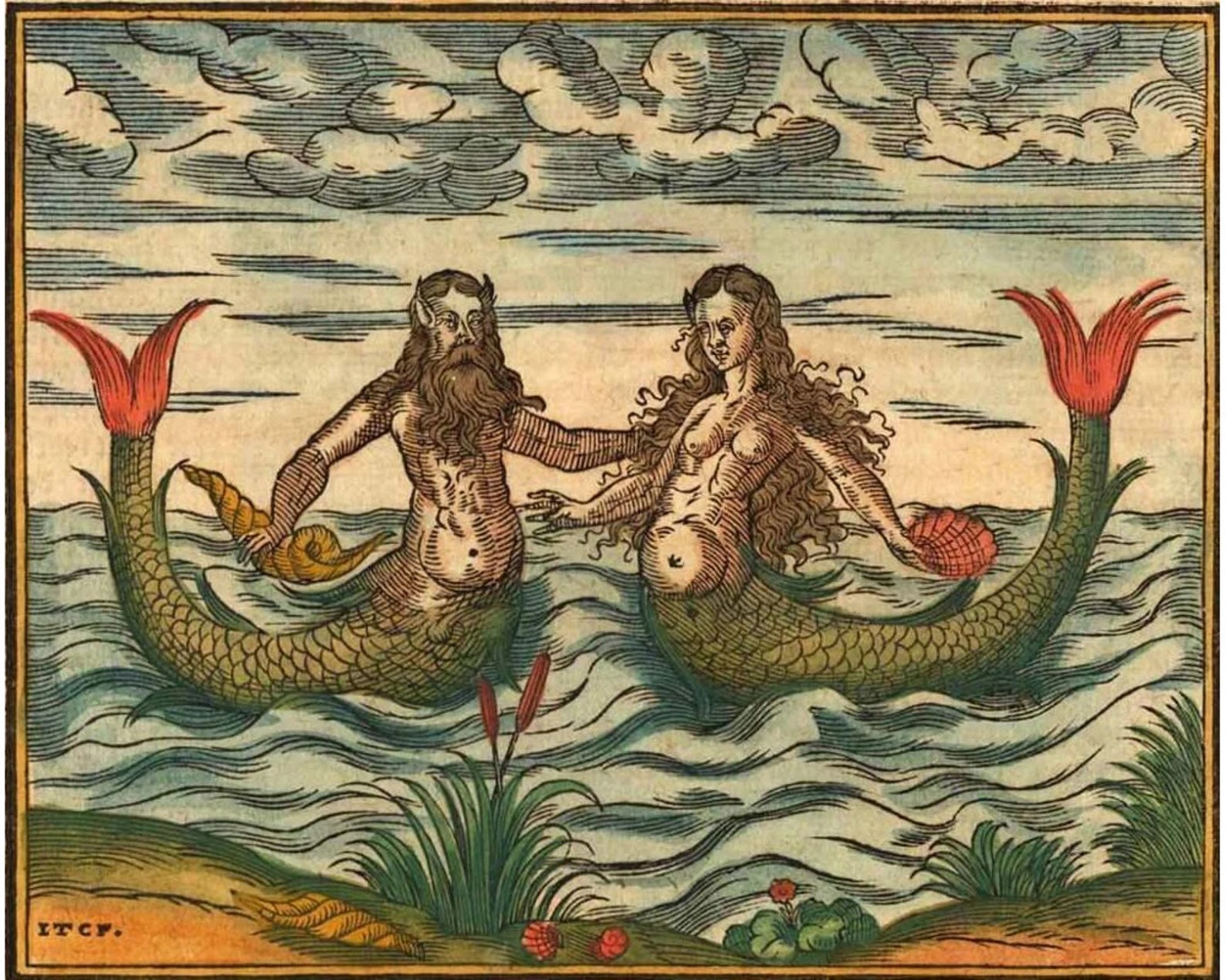
~ Medieval MerPeople ~
Mermaid & Merman

Monday, June 30, 2025

Books With Ellie

One of Ben & Sam's childhood favorites,
now passed on to Ellie, Aidan, and Dean.
Includes "The Highwayman,"
"The Mermaid" & "The Merman"

You just never know when an amazing readerly moment is going to come along and melt your heart or take your breath away. Not long ago, as I was reading with Ellie, now 4 1/2, from an illustrated book of poetry (Eugene Field, Christina Rossetti, Walt Whitman, etc.), she stopped me to say, in a kind of detached dreamy way, "It's really nice isn't it?"

I thought she meant the artwork and started to comment on some colorful details bordering the edge of each page, but she held up her hand and pressed her palm right in the middle of the text and said, "No, I mean this. What makes it so nice?"

I had mistakenly assumed that she was just daydreaming about the pictures while I was basically reading aloud to myself; but, in fact, without any pointers or tutorials, she was grasping the concept of poetry and writing of quality.

Around the same time, I was writing about the concept of ut pictura poesis (on my Quotidian blog) and thinking about the related argument that painting takes precedence over poetry (but does it?) because we value sight over hearing. On the contrary, Ellie bypassed the visual and knew instinctively that she was hearing something "really nice." So intriguing -- both her appreciation of poetic verse and also her palpable gesture of reaching out to touch the words!

Ellie is also a fan of library storybooks, many of which contain their own subtle literary motifs. The other day we were reading a couple of her favorite books, both by the same author, one featuring a pig who likes to read -- that would be The Book Hog (2019) -- and the other one featuring a crocodile who likes watermelon but fears The Watermelon Seed (2013).
More about Greg Pizzoli
Ellie pointed out to me that when the Book Hog goes to the library, he picks The Watermelon Seed for Show & Tell! Naturally, I took a moment to explain to her about intertextual puns and mise en abyme.

A few nights later, in a completely different book, a character had taken a grocery cart to the library. I said, “like the crocodile who wants to check out all the books.”

Ellie said, “I think you mean the Book Hog, Amma, not the crocodile.”

She's always one step ahead! Nearly ready for kindergarten -- or should I say grad school!